Service Environment Analysis
Introduction
Service marketing refers to the integrated system of entrepreneurial activities designed to price, plan, promote, and distribute the right services to benefit existing and potential clients to attain the objectives of the organization (Jha, 2000). The services marketing perception focuses on the sale of services that will be of best interest to clients (Turker et al. 2019). Therefore, services marketing entail the coordinated and systematic effort of a service organisation for the expansion of its market through the delivery of the most ideal services.
The aims of the services marketing module at the University of Liverpool include; introducing students to modern thinking and debate on marketing’s service-dominant logic, coming up with a consumer perspective on service experiences, and identifying the way sensory perceptions affect affective and cognitive responses to a service environment. The contents of the coursework are categorized into six broad topics; introduction to services (characteristics of services, the extended services marketing mix, the service value proposition, and service experiences), service environment (physical environment) (physical environment, SOR model and servicescape model, and understanding ‘scapes’ ), value co-creation and service-dominant logic (from goods dominant logic [GDL] to services dominant logic[SDL], axioms and process of SDL, links between value co-creation and SDL, and consumer experience and co-creation), people (recruitment and training, emotional labour, and internal marketing), including service quality and processes (processes, service quality, and SERVQUAL dimensions), and services in a changing landscape (changing context where service is delivered and experienced, opportunities and challenges).
It is from an individual understanding of these topics that this service environment analysis report will explore physical evidence (ambient conditions and space/function) and actors (customers and employees) in a restaurant. The restaurant is for those looking for a unique dining experience: “Relish an exquisite dining experience with live entertainment, interactive activities, and unforgettable ambience”.
Physical Evidence in the Service Environment
Today’s clients are looking for a memorable restaurant encounter, and servicescapes are a really important constituent of this experience. Bitner’s servicescape model proposes that there are physical elements in the servicescape that a service provider can regulate to improve employees’ actions and customer satisfaction (Bitner, 1992). Hence, the physical environment of a restaurant is one of the critical elements in the attraction and satisfaction of clients in the food and beverages sector (Turker et al. 2019). The significance of the physical environment in restaurants has become more pronounced, with scholars researching the effect of physical evidence on client satisfaction (Egle and Maria, 2012; Kotler, 1983). In this section, the report will explore the effects of ambient conditions and space/function on customer satisfaction in a restaurant servicescape.
Ambient conditions
Ambient conditions refer to the intangible background attributes that affect all five senses of an individual and may subconsciously affect clients. These background attributes include lighting, temperature, music, noise, and scent (Jain and Bagdare, 2011). Similarly, Bitner (1992) agrees and asserts that ambient elements are intangible attributes that affect a person’s responses to the environment and they are inclusive of background attributes of the internal physical environment, like temperature, lighting degree, background music, and aroma. Rhu and Jang (2008) assert that the significance of ambient elements in creating an image and enhancing customer satisfaction is especially critical in the food and beverages sector. Similarly, Ali and Amin (2014) researched the extent to which physical servicescape affects client satisfaction and customers’ emotions in Chinese resort restaurants. The research uncovered that ambient elements that influence the customers and the reactions to the influence of the environment are very robust indicators of a company’s sustainability. Ambient elements were viewed as representative of the background stimuli that are perceived as influencing customers’ feelings (Maghanga et al. 2023). Hence, ambient elements affect employees’ actions and customer satisfaction. The different ambient elements have distinct effects on customer satisfaction and employee action as discussed in the subsequent sections.
- Colour
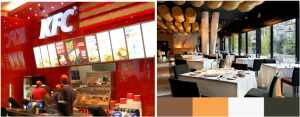
There are many aesthetics in a restaurant, but colour is the most important characteristic since it is critical in creating customers’ first impression of the servicescape (Maghanga et al. 2023). Colours possess distinct behavioural connotations and affect the perception and states of mind of several physical qualities of the immediate environment. Therefore, when colours are applied resourcefully in designing these environments, the colours can influence clients’ emotional states, making them excited and happy. Levy and Weitz (2012) concur, stating that colour not only gives individuals objective information but also influences people’s feelings. Colour is even more important in interior environments as it helps in generating positive emotions like comfort, warmth, and calmness.
Figure1. Colour in a Fast Food and an Exquisite Restaurant
- Lighting
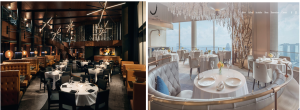
A restaurant service provider can design lighting to guide clients’ movement through a space or design it to positively influence clients to appreciate a space. In restaurants, Kisang and Han (2010) assert that lighting can be one of the strongest physical stimuli in restaurants, especially for upscale restaurants. In fast-food restaurants like McDonald’s, bright lighting may signify relatively low prices and fast service. However, warm and subdued lighting may symbolize a restaurant that offers full services at high costs (Kisang and Han, 2010). Therefore. Bright lighting with walls coloured orange induces feelings of low price and low-quality eateries, while soft lighting increases the perception of high costs and high quality.
Figure 2. Lighting and lighting fixtures in two different exquisite restaurants
- Music
Music is not only at the heart of most people, but it is also a great mood enhancer. Music has a soothing effect on people when they need relaxation and it also has the power to affect our behaviour and attitudes (Maghanga et al. 2023). Therefore, when music is used effectively in a restaurant, it can create a comforting atmosphere increasing client satisfaction. Fast music increases a restaurant’s customer turnaround while slow music increases individual spending from a customer (Maghanga et al. 2023). As such, to create an exquisite atmosphere at the restaurant, the right music tempo would need to be played.
Space/Function
Kisang and Han (2010) define spatial layout as how equipment, facility, and furnishing are arranged, the shape and size of the items, and the spatial relationship among these items. Functionality, on the other end, is the ability of equipment, facility, and furnishing to facilitate clients’ comfort and enjoyment. For instance, an effective functionality and layout will provide for exits and entrances and at the same time provide for ancillary areas like playrooms and restrooms with ease which creates a positive impression for restaurant clients. When spatial layout constricts customers’ movement, it may directly influence their quality perceptions reducing the chances of a client getting an exquisite experience in a restaurant.
Actors in the Service Environment
In the food and beverage sector, the services are highly interactive and people–oriented. The services involve significant interaction between customers and the service providers. Therefore, employees can dissatisfy or satisfy clients. Most people who frequent restaurants commence their evaluation of the dining experience as soon as they have a service encounter in the restaurant and with the employees at the restaurant (Lin and Mattila 2010). Service encounter refers to the ‘moment of truth’ that can be described as any interaction that a client may have with the restaurant (that is other clients in the establishment or the employees) throughout their stay (Lin and Mattila 2010). At any given truth moment, clients start assessing their level of satisfaction with the employee. As such, the service quality concept is strongly linked with customer satisfaction or dissatisfaction. Service quality can be described as clients anticipating service perfection from service organizations. Hence, those service organizations that are competitive will attempt to adopt several recovery structures to assist in attaining zero defects and lower the chances of failures in service delivery to improve positive service encounters.
The emphasis on the significance of service encounters in influencing customer satisfaction has also been in the practical domain and academic research. How frontline employees behave is important to customer evaluations of a service. Hence, it is not surprising that quality services are a strategic weapon used by service providers to increase customer satisfaction in the current crowded marketplace. Dickson et al. (2016) assert that there is increasing literature concentrating on the advantages of providing quality services to clients. As such, most service providers are focusing on employee training as a strategy to increase employee performance, motivation, and productivity (Bitner, 1992). Therefore, client-employee interaction influences client satisfaction in a restaurant servicescape due to the service presentation aspect.
Service presentation is linked to the qualifications, physical appearance, and behaviors of employees. Employees in an exquisite restaurant have a significant impact on clients’ attitudes, loyalty and buying intentions. The frontline service providers’ behaviors are important to clients’ evaluations of the service received during their stay. According to Hill et al. (1989), the competence of the staff is the most critical criterion used by clients in their subsequent service providers’ selection. Moreover, the physical appearance of employees can significantly improve the service experience. Turker et al. (2019) insist that employees’ physical attractiveness, a physical demeanour that is pleasing through colourful and clean uniforms and proper personal grooming plays a major role in enhancing the restaurant’s image. In their research, Vilnai-Yavetz and Gilboa (2010) found that the perceived neatness and cleanliness of the waiter’s uniforms were positively correlated with customers’ increased trust and feelings of pleasantries. Therefore, employee physical presentation significantly contributes to reinforcing the desired exquisite experience in the restaurant.
Further, given the need to offer exquisite services to clients, service excellence has to be achieved by the employees. As conceptualized by Johnston (2007), service excellence involves employees handling problems, delivering promises, going the extra mile, and personalization. To ensure that these expectations are met, a restaurant has to hire the right kind of employees. Employees who will effectively and promptly share the right information with customers at all times. Information sharing in an exquisite restaurant may entail explaining the recipe, menu, and cooking procedure to clients (Li and Hsu, 2018). Additionally, employees need to personalize the services they offer to customers by using a name to address the regular clients or recognizing a regular customer’s change in appearance. This behavior helps to establish and maintain a great rapport with clients (Hyun and Kim, 2014). This level of service excellence can only be achieved when the right set of employees are hired.
Restaurant employees in an exquisite hospitality servicescape should be able to adequately and effectively deal with guests’ problems. Employees’ ability to stay calm, apologetic, emphatic, and genuine are important attributes. Additionally, employees should get authorization from the service provider to offer clients compensation packages like free meal coupons when the meal served is below client expectations. Such efforts are perceived as primary drivers of clients’ emotional attachment to a restaurant. For this reason, the hiring team for the exquisite restaurant should develop a professional approach to locating and developing the right personnel to serve in the servicescape.
However, besides employee-customer interaction influencing customer satisfaction, customer interactions within themselves influence clients’ perceptions of service satisfaction and quality. Customer-to-customer interactions (CCI) significantly influence clients’ emotions, experiences, and satisfaction (Tuzovic et al. 2021). For instance, when other customers invade the personal space of other customers (Tuzovic et al. 2021), it may trigger negative emotions for the customers whose personal space was invaded, which in turn tarnishes the brand of the exquisite restaurant.
Conclusion
The physical and social elements in a servicescape environment influence customer satisfaction in restaurants. Some of the physical elements that influence customer satisfaction include ambient conditions and space and functionality in a restaurant. Ambient conditions that include colour, lighting, and music are critical determinants of client satisfaction in a restaurant determined to offer exquisite services to its clients. Customers use ambient elements to assess the state of a restaurant and determine its suitability in offering comfort. Music also determines whether clients remain in the restaurant for a little while or stay longer which increases their spending during a single sitting. The faster the music played in the background the higher the customer turnover but the lesser the amount spent by clients in every sitting.
In addition to ambient conditions, space layout, and functionality significantly contributes towards customer satisfaction. Customers are more satisfied in exquisite restaurants that have clearly defined their spaces; kitchen, dining areas, serving areas, playrooms, entry, and exists. Moreover, clients have increased satisfaction when the furnishings in the eating area are well-arranged providing adequate space to allow for movement without having to intrude to another customer’s personal space.
Social elements also influence customer satisfaction. Social elements encompass employee-customer interactions and customer-to-customer interactions. There is increased customer satisfaction when employees personalize client services, effectively handle client problems, go the extra mile to respond to clients’ queries, and share information with clients on the menu, restaurant itinerary, and physical presentation. When employees adorn neat and clean uniforms and observe their glooming, it increases client satisfaction. Client satisfaction is also increased when employees go the extra mile to build a rapport with the client. However, for employees to achieve such levels of service excellence, the hiring team for a restaurant would have to hire the right employees and introduce effective programs that will help maintain their skills.
Recommendations
- To improve actors’ experience
Although the hospitality industry is complex given its intangible nature, the service environment analysis shows that physical and social environment elements increase customer satisfaction. Therefore, this report recommends that restaurant managers invest in the layout, space, and comfort of the dining chairs and tables in the eating area. The chairs and tables must be arranged in a manner that provides spacious and ample space for customers to enjoy their meals while conversing without intruding on the possibility of personal space intrusion. Secondly, hoteliers should invest in the continuous enhancement of colour on surfaces and proper lighting to promote the aesthetic value of the restaurant. Third, employees should be engaged in periodic customer service and rapport-creating training to ensure that they are fully equipped to handle clients and solve clients’ problems.
- To enable consumer value co-creation
A service provider should not presume that their lighting or overall aesthetic preference is attractive to customers. Instead, service providers should enable consumer value co-creation by encouraging feedback, establishing a client-centric business model, continually communicating with customers, and supporting diversity within the establishment. Value co-creation is an effort that is collaborative between an establishment and its clients. Therefore, a restaurant interested in establishing a customer-centric business model may begin contemplating what they would do for their clients and in turn, put clients’ needs first. More importantly, for an establishment interested in succeeding, communicating with customers is important as it attracts client interest and they may offer feedback on proposed changes or enhancements in service delivery. Lastly, an exquisite restaurant should encourage fairness regardless of a client’s affiliation, origin, or status as it shows the service provider’s sense of commitment and clients are more at ease to add value to the enterprise.
Reference List
Ali, F., and Amin, M. (2014). the influence of the physical environment on emotions, customer satisfaction, and behavioural intentions in the Chinese resort hotel industry. Journal of Global Business Advancement, 249 – 266.
Bitner, M. (1992). Servicescapes: the impact of the physical servicescape on customers and employees. Journal of Marketing, 57 – 71.
Dickson, T. J., Darcy, S., Johns, R., and Pentifallo, C. (2016). Inclusive by design: Transformative services and sport-event accessibility. The Service Industries Journal, 532 – 555.
Egle, C., and Maria, M. (2012). The role of the perceived servicescape in a supermarket. Sweden: Jonko Ping.
Hill, C., Garner, S., and Hanna, M. (1989). Selection Criteria for Professional Service Providers. Journal of Services Marketing, 61 – 69.
Hyun, S., and Kim, I. (2014). Identifying optimal rapport-building behaviors in inducing patron’s emotional attachment in luxury restaurants. Journal of Hospitality and Tourism Research, 162 – 198.
Jain, R., and Bagdare, S. (2011). Music and consumption experience: a review. International Journal of Retailing and Distribution Management, 289 – 302.
Jha, S. (2000). Services Marketing. Mumbai: Himalaya Publishing House.
Kisang, R., and Han, H. (2010). “Influence of Physical Environment on Disconfirmation, Customer Satisfaction, and Customer Loyalty for First-time and Repeat Customers in Upscale Restaurants. International CHRIE Conference-Refereed Track, Paper 13.
Kotler, P. (1983). Atmospherics As a Marketing Tool. Journal of Retailing, 48 – 64.
Li, M., and Hsu, C. (2018). Customer participation in services and employee innovative behaviour. International Journal of Contemporary Hospitality Management, 2112 – 2131.
Lin, I. Y., and Mattila, A. S. (2010). Restaurant Servicescape, Service Encounter, and Perceived Congruency on Customers’ Emotions and Satisfaction. Journal of Hospitality Marketing and Management, 819 – 841.
Maghanga, E. M., Nthiga, R., and Burugu, R. (2023). Influence of Ambient Conditions on Customer Satisfaction in Selected Universities, Nairobi Kenya. Journal of Hospitality and Tourism Management, 55 – 67.
Rhu, K., and Jang, S. (2008). Influence of restaurants‟ physical environments on emotion and behavioral intention. Services Industries Journal, 1151 – 1165.
Turker, N., Gokkaya, S., and Acar, A. (2019). Measuring the Effect of Restaurant Servicescapes on Customer Loyalty. Tourism Academic Journal, 255 – 270.
Tuzovic, S., Kabadayi, S., and Paluch, S. (2021). To dine or not to dine? Collective wellbeing in hospitality in the COVID-19 era. International Journal of Hospitality Management.
Vilnai-Yavetz, I., and Gilboa, S. (2010). The Effect of Servicescape Cleanliness on Customer Reactions. Services Marketing Quarterly, 213 – 234.